Industrial IoT Digital Twin & Predictive Maintenance Platform
AI-powered Indstrial Predictive Maintenance Platform
Overview
A real-time industrial digital twin platform for predictive maintenance using IoT sensors, Firebase, Google Cloud infrastructure, and machine learning-based fault detection.
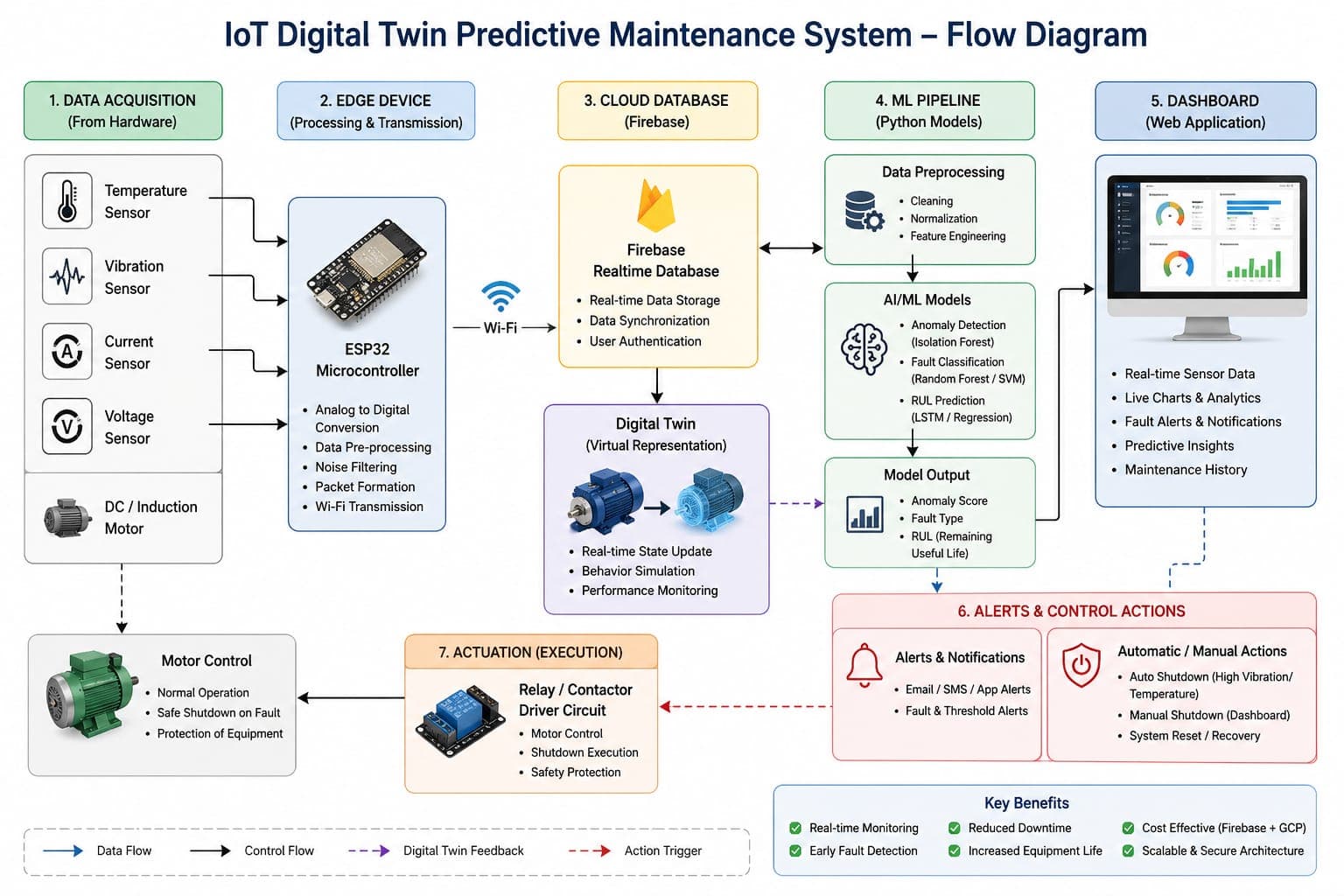
This project focused on building a complete industrial IoT ecosystem capable of monitoring machine health in real time using ESP32-based sensors and cloud-connected telemetry pipelines. The system streams live sensor data through MQTT into Firebase and Google Cloud services, where telemetry is processed for predictive maintenance insights and anomaly detection. Machine learning models were deployed on both edge devices and cloud infrastructure to classify faults, predict Remaining Useful Life (RUL), and reduce industrial downtime. A modern React.js dashboard visualizes real-time sensor activity, anomaly alerts, analytics, and operational health metrics for industrial monitoring environments.
- Category
- AI & IoT
- Year
- 2025
- Role
- Full Stack Developer
Technologies
Tech Stack
14 technologies across 5 layers
frontend
3- React.js
- Chart.js
- Tailwind CSS
backend
3- Node.js
- Python
- Firebase Functions
database
2- Firebase Firestore
- MongoDB
cloud
2- Google Cloud Platform
- Firebase
tools
4- MQTT
- ESP32
- ONNX Runtime
- Raspberry Pi
Key Features
Real-time telemetry streaming using MQTT and Azure IoT Hub
Live industrial monitoring dashboard with React.js
Predictive maintenance using machine learning models
Fault detection with Isolation Forest and Random Forest
Edge inference deployment using ONNX on Raspberry Pi
Real-time sensor charts and automated alert system
SHAP-based explainability visualizations for ML predictions
Scalable cloud-connected industrial architecture
Challenges & Solutions
01
Streaming and processing continuous high-frequency sensor telemetry without introducing latency in the monitoring system.
Implemented an optimized MQTT-based communication pipeline integrated with Azure Stream Analytics for low-latency real-time processing and efficient telemetry handling.
02
Deploying machine learning models on edge hardware while maintaining fast inference speeds and low memory consumption.
Converted trained models into ONNX format and optimized them for Raspberry Pi deployment, achieving sub-100ms inference performance for real-time fault predictions.
Gallery

Up Next
Cloud-Native AKS ETL Pipeline
Cloud & DevOps — 2025